Rich's Custom Embroidery and Apparel
Get a Free Quote

Embroidery services, done in-house

Seven ways to put your mark on a garment — from a single monogrammed gift to a full run of embroidered company jackets. Every service below is produced at the Aurora Ave N shop.
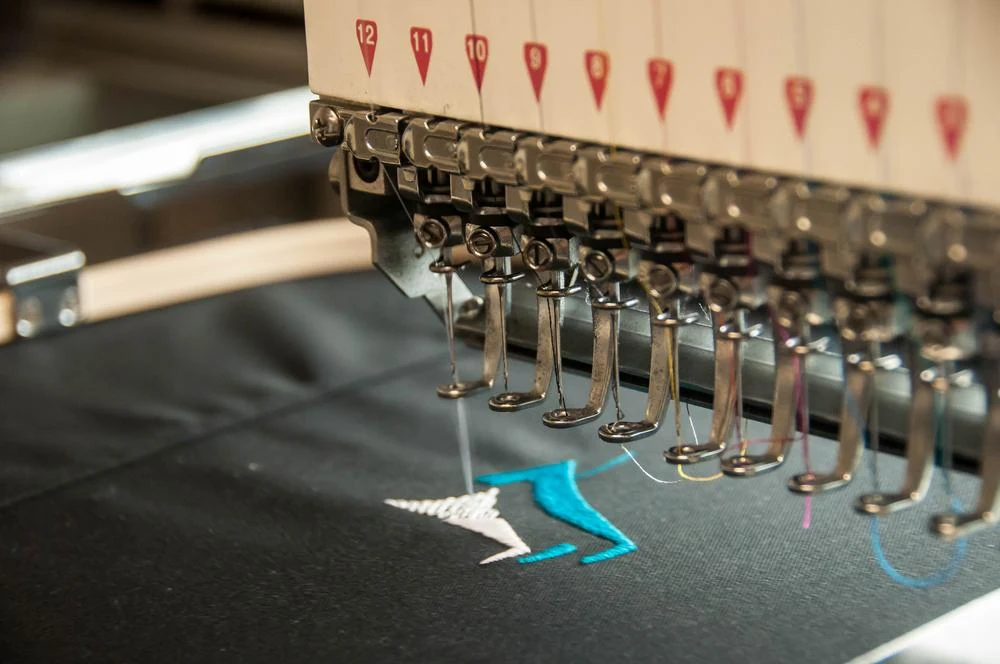
Detailed logo embroidery being stitched onto fabric with dense coloured thread

Most requested

Custom Logo Embroidery

Your company mark, stitched onto polos, caps, aprons, workwear, fleece and jackets. The goal with logo work is consistency — the hundredth garment has to match the first, in placement, size and thread colour.

Small text and fine gradients are where most logos run into trouble. Thread has a minimum practical size, and detail below that closes up into a blur. You'll get a straight answer up front on whether your mark needs simplifying for the size you want, rather than discovering it after the run.

  • Left chest, sleeve, back and cap-front placements
  • Consistent colour matching across a full run
  • Advice on simplifying fine detail so it stitches cleanly
  • Works on polos, caps, jackets, fleece, aprons and bags
Best for Businesses, teams, uniforms and staff kit
Embroidered Greenwood Car Show patch in green and gold with decorative border

Club & event favourite

Custom Patch Creation

Morale patches, event badges, club crests and team patches, finished with a clean merrowed edge so they don't fray. Backing options cover iron-on, sew-on and hook-and-loop depending on whether the patch needs to move between garments.

Patches carry bold, graphic artwork better than almost any other format — strong shapes, limited colours and clear outlines. The Greenwood Car Show patch is a good example: two colours, heavy satin lettering, and a shaped border that holds its edge.
  • Custom shapes and sizes cut to your artwork
  • Merrowed or laser-cut edge finishing
  • Iron-on, sew-on and hook-and-loop backings
  • Bold two- and three-colour designs stitch best
Best for Car clubs, events, teams, uniforms and collectors
Close-up of fine monogram embroidery detail in thread on textured fabric

Gifts & keepsakes

Personalized Monogramming

Initials, names and dates on gifts, robes, towels, wedding items and keepsakes. Monogramming is the most personal work in the shop, and usually the most time-sensitive — it tends to be tied to a date that can't move.

There's real choice here that's worth talking through: script versus block, thread colour against fabric colour, and where the monogram sits on the piece. Those three decisions do most of the work in making it look considered rather than added on.
  • Script, block and decorative lettering styles
  • Guidance on placement and thread colour
  • Single items welcome — no minimum order
  • Rush requests accommodated where the schedule allows
Best for Weddings, gifts, personal items and household linens
Metallic thread embroidery detail showing raised goldwork texture

Specialty tier

Goldwork & Metal Thread Embroidery

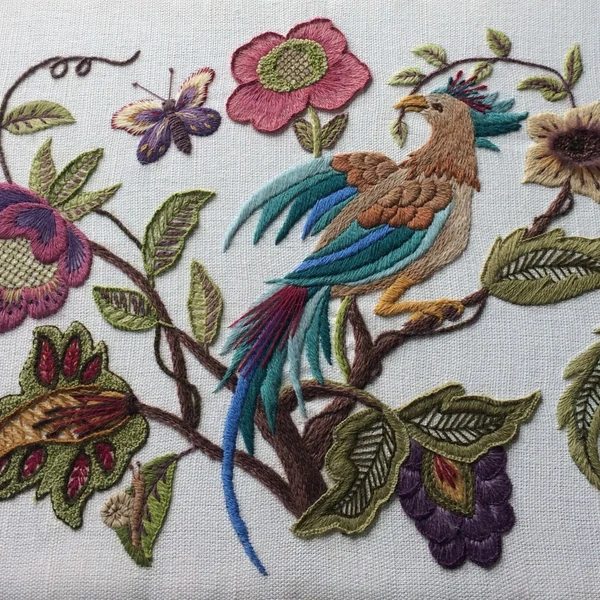
Goldwork is the oldest and most demanding technique in the shop. Metal threads don't behave like rayon or polyester — they're stiffer, they catch the light differently, and much of the traditional work is couched by hand rather than passed straight through the fabric.

The result is a raised, light-catching surface that no flat stitch can imitate. It belongs on regalia, ceremonial pieces, badges of office and heirloom work — pieces meant to last and to be looked at closely. This work is quoted individually and takes longer than standard embroidery.
  • Traditional couched metal thread techniques
  • Raised, dimensional, light-catching finish
  • Suited to regalia, insignia and commemorative pieces
  • Quoted individually — longer lead time than standard work
Best for Regalia, ceremonial pieces and heirloom work
Printed full-colour transfer applied to fabric showing fine gradient detail

Full-colour artwork

DTF Printing for Hats & Shirts

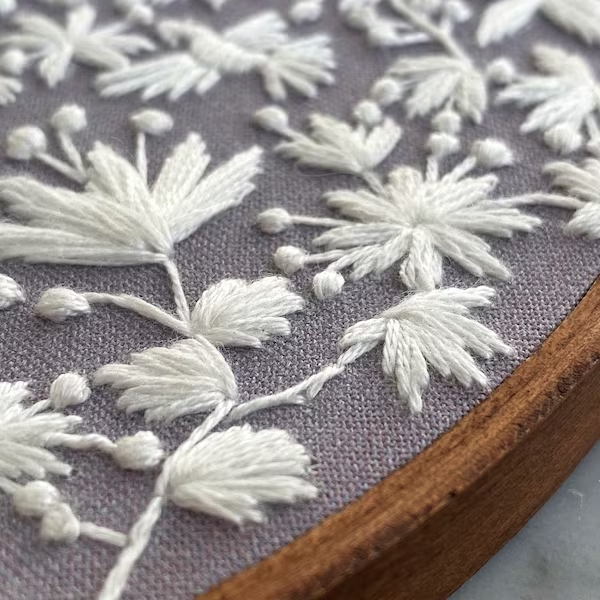
Direct-to-film transfers handle the artwork embroidery can't: photographic images, gradients, fine text and unlimited colour counts. The design is printed onto film, then heat-pressed onto the garment.

DTF is usually the right answer for complex or full-colour designs, and for small runs where digitizing an intricate logo wouldn't be worth it. It sits flat on the fabric rather than raised, so it's a different look from thread — not a lesser one, just suited to different artwork.
  • Unlimited colours with no extra setup per colour
  • Handles photographic detail and smooth gradients
  • Works on hats, shirts, hoodies and blends
  • Cost-effective for short runs and one-offs
Best for Full-colour designs, photos, gradients and small runs
Ornamental decorative embroidery worked in multiple thread colours

Artistic work

Decorative Embroidery

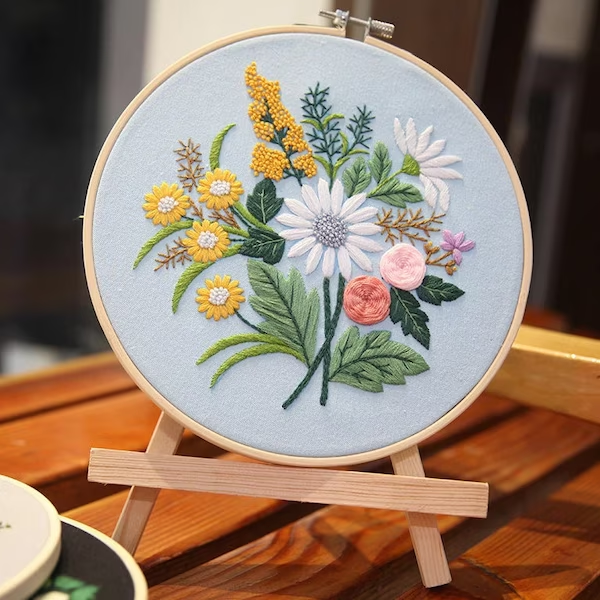
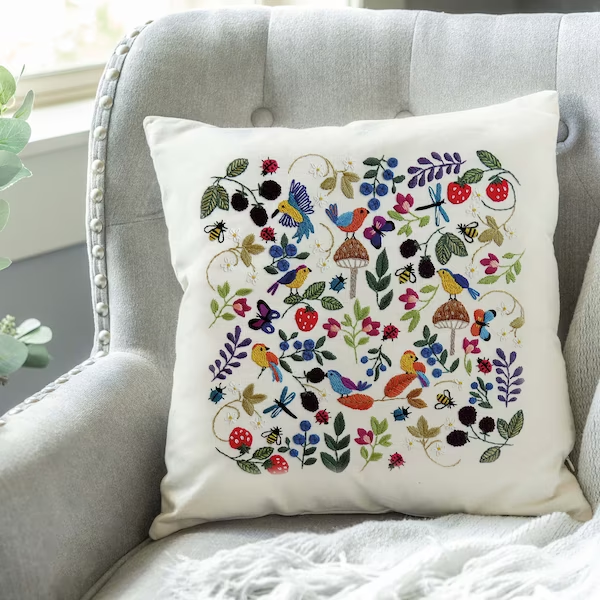
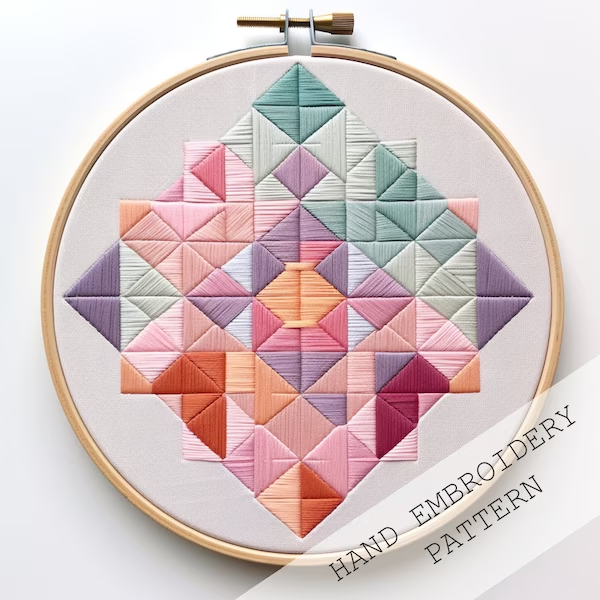
Ornamental stitchwork for pieces where the embroidery itself is the point — not a logo applied to a garment. Borders, floral and geometric motifs, and decorative panels on clothing, home textiles and accessories.

This is open-ended work and it starts with a conversation about what you have in mind, what the piece is, and how much of it you want covered.
  • Borders, motifs and decorative panels
  • Works on garments, cushions, linens and accessories
  • Design developed with you from the outset
  • Single pieces and small runs welcome
Best for Home textiles, clothing detail and artistic pieces
Traditional cultural embroidery pattern stitched in bright contrasting threads

Heritage motifs

Regional & Cultural Embroidery

Traditional and regional motifs stitched with attention to how the pattern is actually supposed to sit — the spacing, the stitch direction, and the colour relationships that make a heritage design read as authentic rather than approximated.

Bring reference images or an existing piece and we'll work from those. If the pattern has rules, it's worth getting them right.

  • Worked from your references or an existing piece
  • Attention to traditional spacing and stitch direction
  • Suitable for garments and display pieces
  • Discussed in detail before any stitching begins
Best for Cultural garments, heritage pieces and commemorative work

How Pricing Works

Why there's no price list on this page

Embroidery isn't priced per item — it's priced on how much thread and machine time your design actually takes. Three things decide it.

Stitch count

The single biggest factor. A larger, denser design needs more stitches and more machine time. A small left-chest logo and a full back design are different jobs.

Garment & placement

Caps, jackets and structured items take more setup than flat garments. Some fabrics need stabiliser or a slower run to hold the stitch cleanly.

Quantity

Digitizing happens once, then the setup cost spreads across the run. Larger orders cost less per piece — but single items are always welcome.

Every quote is free, and there's no obligation

Send your artwork with a rough quantity and garment type, and you'll get a real number back — not a range designed to get you on the phone.

Questions

Frequently asked

Embroidery is priced on stitch count, not guesswork. A design's stitch count depends on how large it is and how densely it's filled, and that — combined with the garment type and how many pieces you need — sets the price. That's why there's no menu of fixed prices here: a small left-chest logo on 12 polos and a large back design on 3 jackets are genuinely different jobs. Send your artwork and you'll get a real number, free.
No. Single items are welcome, and a good share of the work here is exactly that — one monogrammed gift, one jacket, one patch. Larger runs generally cost less per piece because the setup is shared across the order.
It depends on the size of the run and what's already in the queue. Straightforward jobs often turn around quickly, and rush requests are frequently accommodated — several customers have specifically mentioned last-minute work being completed on time. If you have a deadline, say so when you enquire and you'll get a straight answer on whether it's achievable.
Vector files are best — AI, EPS, PDF or SVG — because they scale without losing edge quality. High-resolution PNG or JPG files also work. If all you have is a photo of an existing patch or a rough sketch, send it anyway; it's usually enough to work from.
Digitizing converts your artwork into a stitch file that tells the machine where every needle penetration goes. It's the step that decides whether the finished piece looks sharp or muddy. It's a genuine skill, and it's why two shops can run the same design on the same machine and get noticeably different results.
Embroidery for logos, text and bold shapes — it's durable, textured and reads as premium. DTF for photographic images, gradients, fine detail or designs with many colours. If you're unsure, describe the artwork and you'll get a recommendation based on what will actually look best, not on what's easier to produce.
Yes, customer-supplied garments are accepted. Bring the item in and it can be assessed for fabric type and stitchability first — some materials and constructions handle embroidery better than others, and it's better to know before rather than after.

Ready when you are

Not sure which service fits your project?

Describe what you're trying to make and you'll get a recommendation based on what will actually look best — embroidery, patch or DTF.

Call Now WhatsApp